

Bottlenecks Institute: Turning Constraints into Catalysts
Launching a Research Organization for Identifying and Addressing Critical Barriers to Progress

Back in April, during San Francisco Climate Week, I co-hosted an event that felt like a quiet catalyst in a noisy year (the administration’s Liberation Day tariff announcement was a few weeks prior). Our event braided capital types, founder firesides that named real constraints, and my first public run of Bottleneck Bingo to map where ventures get stuck (and how to unstick them).
Fast-forward to September: we’re launching Bottlenecks Institute, a research organization to map, conceptualize and help remove the constraints slowing progress across climate, energy, biotech, and AI. Think living “bottleneck cards,” expert interviews, and AI-assisted mapping, paired with the foresight backbone I’ve been refining inside Cool Climate Collective: the Three Futures Test to translate scenarios into investable narratives and coordinated action.
Why a Bottlenecks Institute (and why now)?
The April room made it clear: teams doing systems-level work face the deepest capital and adoption gaps, not because the tech is weak, but because rules, incentives, and institutions weren’t built for what they’re trying to do. When conventional models falter, catalytic capital and coordination are a way for us to correct the market where longer term negative externalities aren’t priced in.
BI operationalizes that insight:
A living repository of regulatory, cultural, technical, and coordination constraints.
AI-assisted mapping + structured expert input to prioritize where marginal dollars and attention can unlock the most progress.
A media/insight layer (pod + briefs) to make the “what’s blocking what” legible to funders, policy, and operators.
Who’s behind Bottlenecks Institute (and why that matters)
We built BI to be multidisciplinary by design, each of us covering a different part of the bottleneck landscape.
James Gray — Hands-on AI Strategy × Operator Discipline
James and I originally met at the Califlorence Climate unconference where we both connected on the ideas of new models and concepts that can be applied to frontier climate technology; he’s an entrepreneur and expert on emerging climate & energy technologies. He’s also the founder of Seren Labs, a data platform that helps investors and corporations discover the climate solutions that are gaining traction and ready for scale. He brings years of expertise and insight into the challenges and opportunities in climate-related industries, and takes a special interest in novel mechanisms and frameworks related to talent, funding, research collaboration, and pilot projects.
Parnian Barekatain — AI for Science × Community Biotech
Parnian spans AI, RL, and synbio: previously at OpenAI, organizing their first OpenAI hackathon; visiting researcher with the MIT Media Lab’s Sculpting Evolution group; an Emergent Ventures grantee for synthetic biology at MIT. She’s also a community convener (recent BI meetups) and a translator between lab-bench ambition and deployment reality, perfect for keeping our “bottleneck cards” current and grounded.
Ian Derrington — Deep Science × Systems Clarity
A physicist and inventor whose early work helped pioneer nanopore DNA sequencing (MspA), Ian brings a rare combo of bench-level rigor and model-builder mindset. His publications in PNAS and related work seeded techniques that underpin modern sequencing; today he channels that pattern-recognition into mapping technical and institutional constraints and explaining them clearly to non-specialists.
and myself 👋, the team’s resident climate investor and foresight practitioner.
Together, we’re designing BI as a human–AI research loop: expert interviews and community input → causal/bottleneck mapping → Three Futures scenarios → who needs to do what & when with public artifacts others can adapt.
NOTE: You’ll also see Parnian & James hosting BI meetups to gather fresh constraints directly from builders.
From Forecast to Force-Multiplier
My contribution comes via a foresight discipline we’ve battle-tested across our early-stage investing: the Three Futures Test. We leverage the test as a way to map ventures or initiatives across plausible futures, score Impact × Revenue × Reach (IR³), and then share scenarios & insights to founders, collaborators and partners so we can coordinate around concrete unlocks, turning foresight from a private edge into a public good.
This is the same scaffolding we used to run Bottleneck Bingo in April, now formalized inside BI, more on that below...
To keep the work usable, not theoretical, we frame each bottleneck with three plausible paths that share the same system spine and diverge only where incentives or shocks differ:
Future One (Momentum): what happens if today keeps happening.
Future Two (Nudge): a concrete change—procurement clause, code update, channel, or proof point—re-weights decisions.
Future Three (Stress): Gray Rhino and Black Swan pressure-tests that check posture and option value, not clairvoyance.
The goal isn’t prediction, it’s pre-decision. Each path ends with “who moves first and in what order,” so when signals blink, coalitions don’t debate, they act.
That’s why each card includes a compact Forecast tab (like the screenshot below):
If you want the deeper mechanics, over the Foresight Methodologies, shared them in a previous write-up, but the essence is simple: shared maps, legible futures, pre-decisions. That’s the foresight through-line from April’s catalytic convening event to today’s research engine.
An Example Card: Insufficient nuclear workforce & expertise
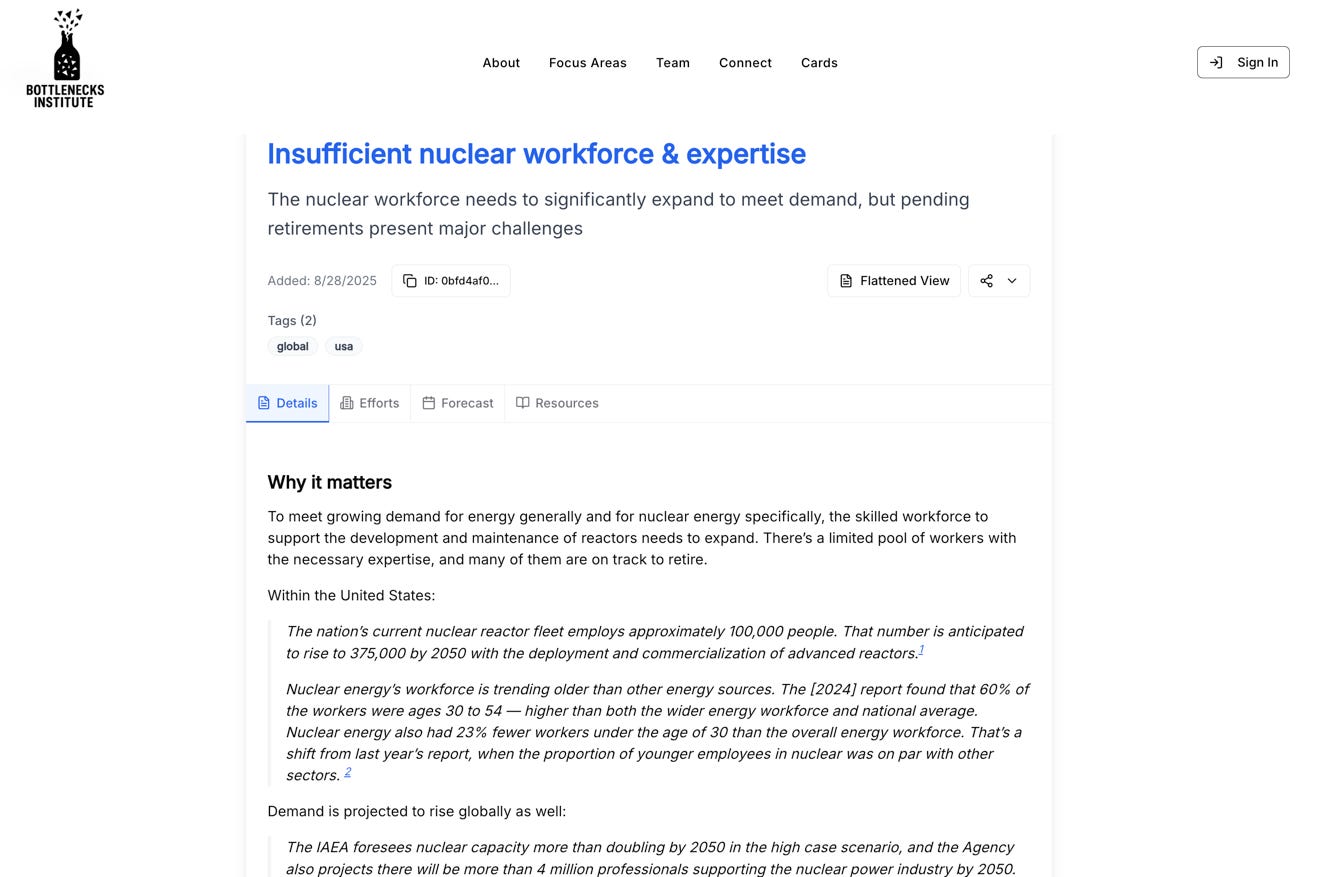
We’ll focus on the core two tabs in the screenshots:
Details — why this bottleneck matters, who it affects, and where it’s showing up.
Forecast — a compact view of plausible paths built off Three Futures Test Methodology, what would have to change, and the signals we’ll watch to know we’re on the right track. (We generate the Forecast after Details, Resources, and Efforts are published, our minimum inputs to run the Three Futures forecasting model for Bottlenecks Institute - if a card is missing a Forecast, likely it’s missing foundational inputs, designed as a safeguard to avoid hallucinogenic forecast modeling).
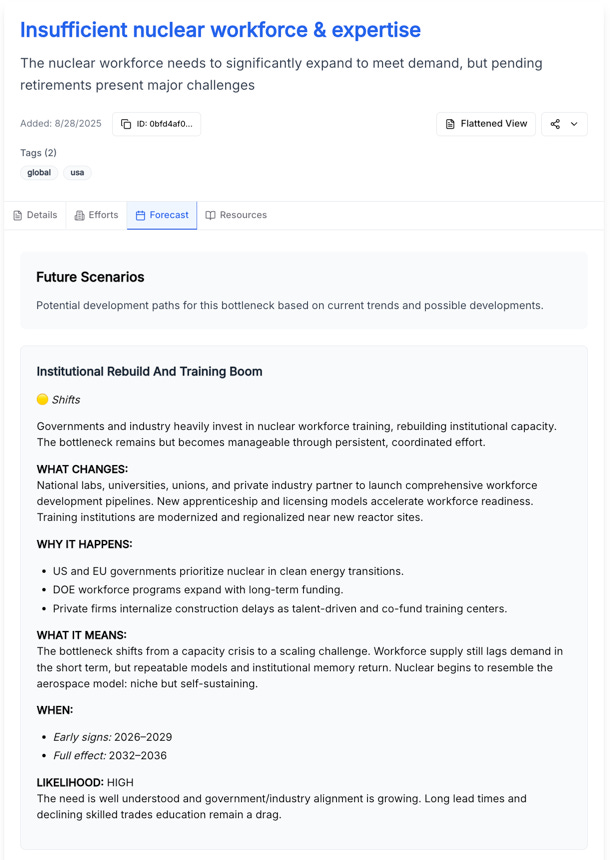
Think of these cards as a shared map. The goal is that a program officer, policymaker, operator, or founder can look once and know: what the obstacle is, which lever to pull, who should pull it, and what evidence would confirm we’re making progress.
What the Forecast is actually doing
Future scenarios: brief, plausible paths (e.g., “Institutional Rebuild & Training Boom”).
Each Subsection:
Shifts (what changes), Why it happens (drivers), What it means (implications), When (early signs vs. full effect), and a Likelihood rating.
Indicators: a handful of measurable signals that tell us a scenario is materializing.
Unlocks: written as if → then (“If fast-track licensing is adopted, then median time-to-hire falls from X → Y”).
Pre-decisions: simple rules that say advance / pivot / pause based on the indicators, so coalitions can move without relitigating.
The card above is one brick in the system we’ve outlined.
We are beginning with problem selection & cause prioritization (via the cards), but as we expand categories; we will improve the Human ↔ AI workflow, to transform these cards into living assets with APIs to form Reports and Impact Metric agents that foundations and funders can use to track portfolio impact in real time (as per the broader market data and foresight projections about the problem area)... just because something is true today when we support it, doesn’t necessarily mean the same is true years from now even if the solution hasn’t changed.
How to plug in
Founders/Operators: Submit the bottleneck you’re wrestling with; we’ll map it, model deltas, and suggest the most leverageable unlocks.
Funders/Policy: Aim capital or policy attention where the modeled delta is highest; we’ll show the “who/what/when” and how to measure signal change. Check out our growing collection of Bottleneck Cards (with many more to be enhanced/under review in the coming weeks)
Researchers/Communities: Join a BI meetup or read/listen to the BI substack.
A note: we are still adding/vetting bottlenecks so our collection of cards shall be growing in the coming months. Additionally what is going on behind the scenes/what can be done with them shall also be able to unlock a new frontier of value to partner organizations and foundations (thanks in large part to Ian & Parnian’s brilliant technical work).
Keep the conspiracy quiet, the coordination loud
If there is one thing we’ve been reminded over the past year, it’s that we don’t win alone. The future belongs to coalitions that can conspire wisely, invest patiently, and build resiliently, and do it with enough humor to stay human while we push against physics and institutions.
Let’s keep getting better at answering: What’s in the way?
And then, let’s move it.